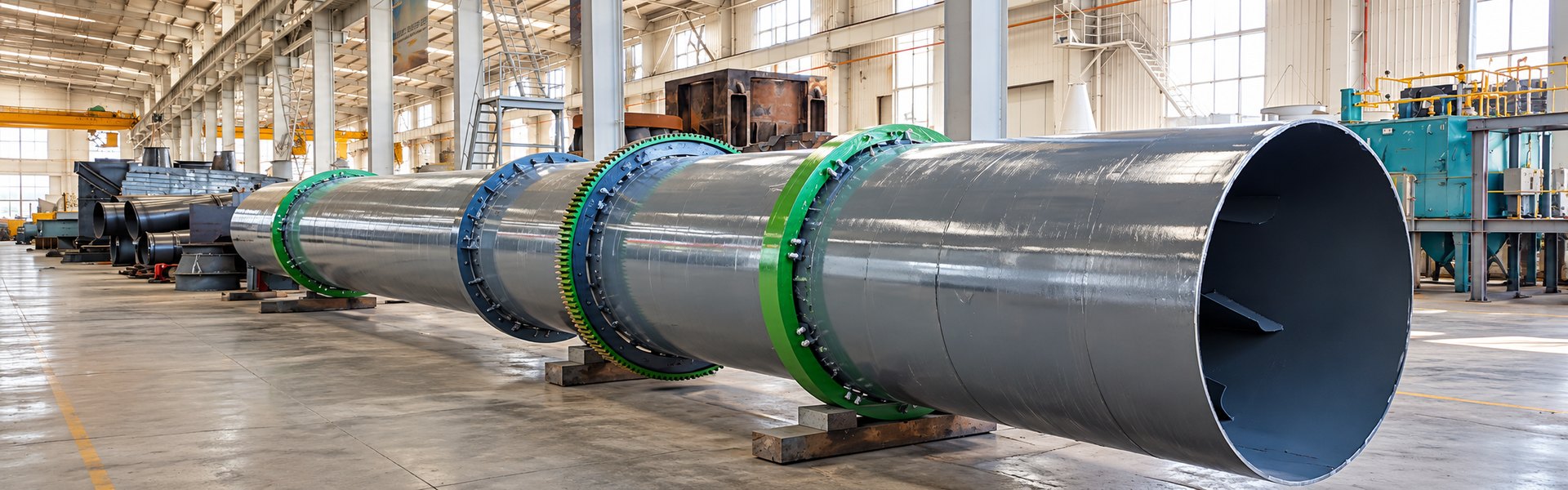
What Is a Rotary Kiln?
A rotary kiln is a large, slowly rotating cylindrical vessel that heats material as it tumbles through from one end to the other, providing continuous, even thermal treatment.
The drum is mounted at a slight incline and rotates about its axis. Material fed at the upper end gradually travels to the discharge end while the kiln turns, so every surface of every particle is exposed to the heat in turn. That combination — continuous flow plus even exposure — is what makes the rotary kiln so widely used.
Rotary kilns operate from a few hundred degrees Celsius for drying to well over 1,400 °C in cement clinker production, and they handle everything from finely divided powders to coarse lumps.
Where the rotary kiln came from
The design has industrial roots going back well over a century. Early continuous cement kilns, lime kilns and ore-roasting furnaces established the fundamental geometry: a long rotating cylinder, a controlled flame, and a steady material path. That same geometry still underlies most of today's kilns, refined by decades of control, refractory and drive engineering.
Why it remains the default
Few other machines combine so cleanly: high throughput, tolerance for a variable feed, and straightforward scale-up. A rotary kiln can process tonnes per hour of a rough, inconsistent feed that a fixed-bed or fluidised reactor would reject. That tolerance is why it anchors so many waste-to-value and minerals processes today.